












Kudos has partnered with CardRatings and Red Ventures for our coverage of credit card products. Kudos, CardRatings, and Red Ventures may receive a commission from card issuers. Kudos may receive commission from card issuers. Some of the card offers that appear on Kudos are from advertisers and may impact how and where card products appear on the site. Kudos tries to include as many card companies and offers as we are aware of, including offers from issuers that don't pay us, but we may not cover all card companies or all available card offers. You don't have to use our links, but we're grateful when you do!

Credit Card Rewards Strategies for Couples: A Two-Player Guide
September 27, 2026




The content on this page is accurate as of the posting date; however, some of the offers mentioned may have expired.
When you and your partner coordinate your cards, your household can earn more points, miles, and cash back than either of you would alone. Rewards fans call this "two-player mode." This guide covers the strategies that work best, from earning two welcome bonuses to pooling points for a bigger trip.
Set Joint Goals and Review Your Spending Together
Start with what you want your rewards to do. Free flights, hotel nights, and cash back toward a big purchase each point you toward different cards.
- Which rewards matter most to both of you?
- Are you saving for a specific trip or purchase?
- How much can you charge each month and still pay every balance in full?
Next, look at your combined spending by category, such as groceries, dining, gas, and travel. If dining is your biggest shared expense, a strong dining card belongs in your lineup. If one partner travels for work, that person may be the natural holder of the household's travel card.

Strategy 1: Each Partner Earns Their Own Welcome Bonus
Welcome bonuses are often the fastest way to earn a large batch of points or miles. When each partner opens a card in their own name, the household can earn two bonuses instead of one.
How to do it: Pick a card that fits your goals, and have each partner apply individually if both qualify. Stagger the applications by a few months so you can comfortably meet one spending requirement before starting the next.
Example: If a card offers 60,000 bonus points after a set amount of spending in the first few months, two partners who each earn it would bring 120,000 points into the household.
Calculation formulated by Kudos, based on a hypothetical 60,000-point welcome bonus earned by two separate cardholders.
Only open cards whose spending requirement fits your normal budget, and keep in mind that each application can cause a small, temporary dip in your credit score. Hold off if either of you plans to apply for a mortgage or auto loan soon. For realistic options, see our list of welcome bonuses you can actually meet.

Strategy 2: Add Each Other as Authorized Users When It Makes Sense
An authorized user gets their own card on the primary cardholder's account. Adding your partner can concentrate shared spending on one strong rewards card and, on some cards, extend certain benefits to the authorized user.
Advantages
- Faster earning on one card: Putting shared purchases on one high-earning card builds that balance of points faster.
- Shared perks: Some cards extend benefits such as travel protections or lounge access to authorized users. Check your card's terms.
- Credit building: Some issuers report authorized user accounts to the credit bureaus. Navy Federal, for example, says it reports account performance in the authorized user's name.
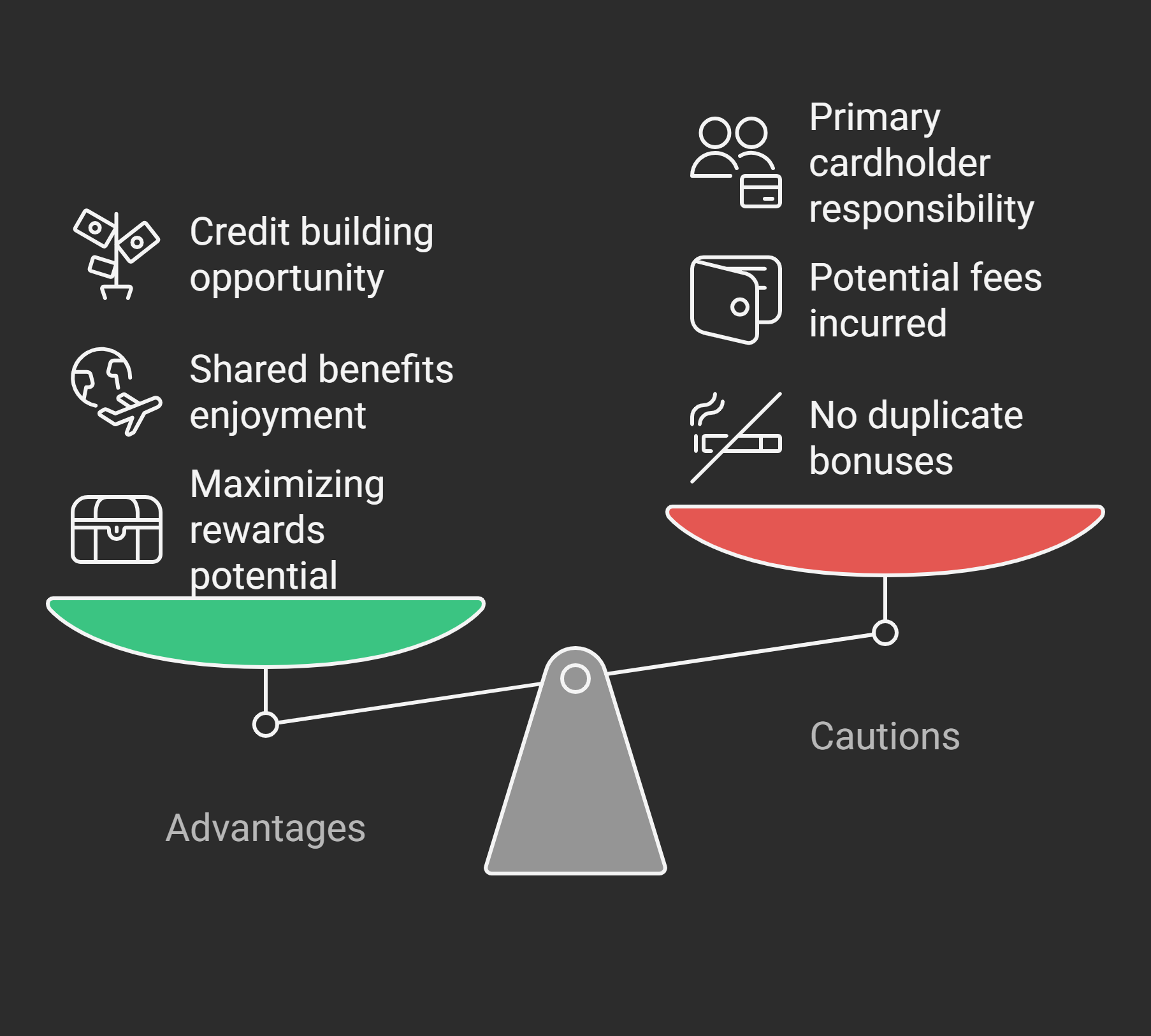
Cautions
- No second bonus: An authorized user does not earn the card's welcome bonus. If your partner could qualify for their own account, a second bonus may be worth more.
- Fees: Some premium cards charge a fee for each authorized user. Make sure the added value outweighs the cost.
- Responsibility: The primary cardholder is responsible for every charge on the account, including the authorized user's. Agree on how you will use the card and pay the bill.
Many couples do both: each partner keeps a few cards for bonuses and specific categories, and they share one or two cards for everyday spending. Our guide on when to get a credit card with your partner walks through the options.
Strategy 3: Divide and Conquer Bonus Categories
Instead of both partners using the same card for everything, build a shared lineup where each card covers the categories it earns best on. Whoever is at the register uses the best card for that purchase, no matter whose name is on it.
A typical household lineup includes:
- A flat-rate cash back card for purchases that do not fit a bonus category
- One or two category cards, such as a dining card and a grocery or gas card
- A travel rewards card for flights and hotels
Partners can add each other's authorized user cards to their mobile wallets, so the right card is always on hand. Just settle up in your budget when one person's card covers a large shared purchase.
Where Kudos helps: Remembering which card earns what at each store gets confusing fast. When you shop online with the Kudos browser extension, Kudos recommends the card in your wallet that earns the most for that purchase and can autofill it at checkout, so neither of you has to memorize the lineup.
Strategy 4: Pool Points for Bigger Redemptions
Points split across two accounts can fall short of a big redemption. Some programs let household members combine them.
Bank Points Programs
Chase says members of the same household can combine Chase Ultimate Rewards® points. You can designate only one person to share points with, that person must share your address, and Chase notes that a transfer cannot be undone, so decide before you move points.
Hotel Programs
Hilton Honors lets members share points through Points Pooling or one-to-one transfers in increments of 1,000 points. Its terms limit each member to sending 500,000 points and receiving 2,000,000 points per calendar year, and new members must wait at least 30 days after enrolling.
Airline Programs
British Airways lets members create a household account to pool Avios with up to six people, and everyone in the household can spend from the pooled balance. Each member still earns tier status individually.
Coordinating Separate Balances
Even without pooling, you can each book one award seat on the same flight from your own balance. Watch expiration rules in each program so neither balance lapses, and agree together on how shared points will be used.
Strategy 5: Use Referral Bonuses
Many issuers reward existing cardholders who refer new customers. If one partner already has a card the other wants, the cardholder can send a referral link from their online account. The new cardholder still earns the welcome bonus, and the referring partner may earn a referral bonus too.
Referral bonuses, terms, and annual caps vary by issuer, so read the offer details before you apply. Also check whether applying through a referral link gives the same welcome offer as applying directly.

Strategy 6: Stay Organized and Communicate
With several cards in play, a little structure prevents missed deadlines and surprise fees. Keep a shared list of:
- Card details: open dates, annual fee dates, and welcome bonus deadlines
- Rewards balances: how many points each of you holds and when they expire
- Spending targets: how much is left to meet any open bonus requirement
A short monthly or quarterly check-in helps you decide whether a card still earns its annual fee and which card should take the next big purchase. Agree on a level of complexity that works for both of you, even if one partner handles most of the details.
How Kudos Helps Couples Get More From Their Cards
You can run every strategy in this guide by hand, but a tool helps when your household has several cards.
- Best card at checkout: Kudos recommends the card in your wallet that earns the most at each online merchant and can autofill it.
- Offer tracking: Kudos Premium automatically activates eligible card-linked offers so fewer of them go unused.
- Card comparison: The Kudos Explore tool lets you compare cards side by side when you are deciding who should apply for what.
For specific card ideas, see our picks for the best credit cards for couples and 7 more ways couples can maximize rewards.
Frequently Asked Questions
How can couples maximize credit card rewards?
Coordinate your applications so each partner can earn a welcome bonus, use authorized user cards where they make sense, cover your main spending categories with complementary cards, and pool points in programs that allow it.
Is it better for couples to have separate cards or share one account?
Separate accounts let each partner earn welcome bonuses and build individual credit. Sharing a card through authorized user status is simpler for everyday spending. Many couples use a mix of both.
Can partners combine credit card points?
It depends on the program. Chase allows combining Ultimate Rewards® points with one household member at the same address, Hilton Honors offers Points Pooling, and British Airways offers household accounts for Avios. Always check the program's current rules.
Who should apply for a new card?
Consider each partner's credit profile, who will use the card's benefits most, and whose spending can meet the bonus requirement. Taking turns on applications spreads out the effect of new inquiries.
What are the risks?
The main risks are overspending to chase rewards and losing track of who owes what. Pay every balance in full, review annual fees together, and cancel or downgrade cards that no longer earn their keep.
Unlock your extra benefits when you become a Kudos member



Turn your online shopping into even more rewards


Join over 500,000 members simplifying their finances



Editorial Disclosure: Opinions expressed here are those of Kudos alone, not those of any bank, credit card issuer, hotel, airline, or other entity. This content has not been reviewed, approved or otherwise endorsed by any of the entities included within the post.